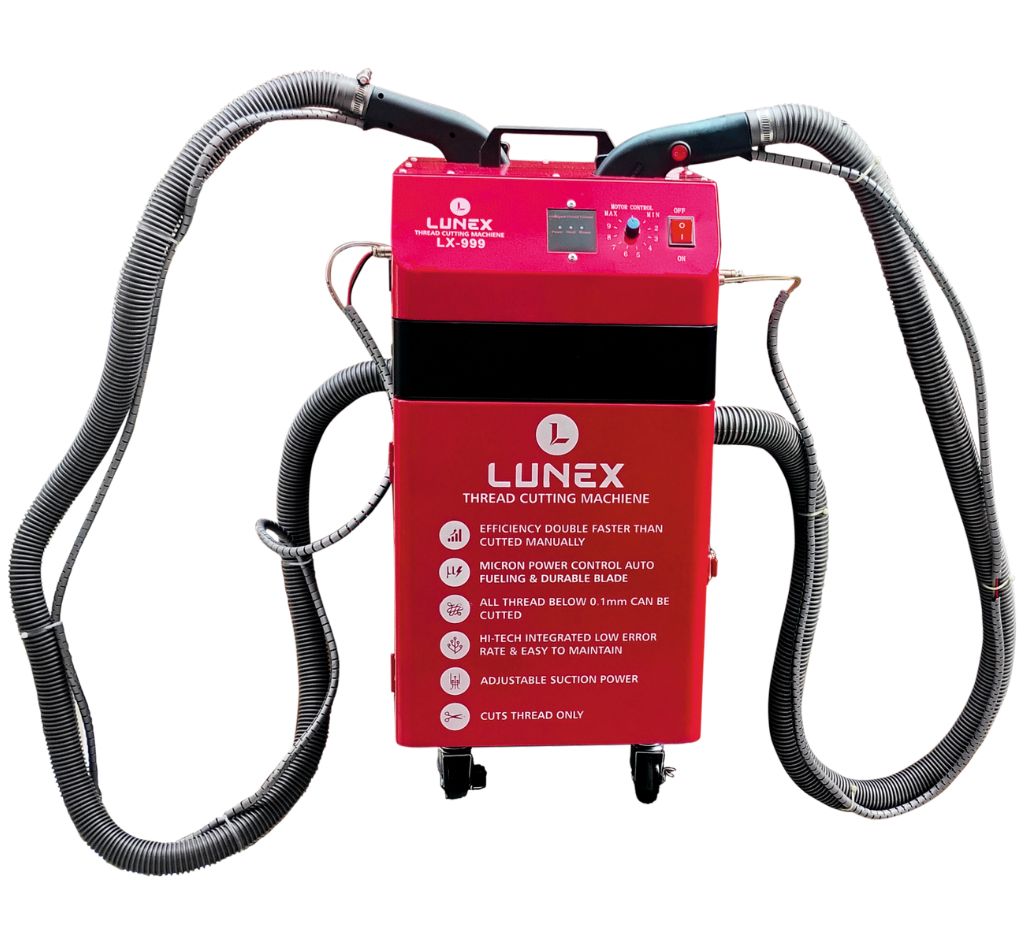
Automatic Thread Trimming Machine: How It Improves Garment Finishing and Production Efficiency
An Automatic Thread Trimming Machine removes loose sewing threads from finished garments using cutting heads and suction, replacing hand trimming with scissors. Its value lies less in cutting speed than in what it does to the finishing stage: more consistent results and fewer hands on a step that is easy to underestimate. It does not fix problems created upstream in sewing, and its benefit depends on how well it fits the flow around it.
## Where the Threads Come From
Every seam leaves ends: at the start and finish of seams, at hems and edges, and wherever an operation does not trim at the sewing head. Under-trimmers built into sewing machines cut the thread at the end of a seam, but they do not remove everything. What remains is visible on collars, cuffs and hems and on light fabrics, and it is a routine point of attention at final inspection. A finishing-stage machine deals with that remainder.
## Finishing as a Workflow, Not a Machine
A common sequence is sewing, thread trimming, final inspection, then pressing and packing, with needle detection added where a factory uses it. The order varies by factory. Trimming sits in the middle of that chain: whatever it leaves goes forward to inspection, and whatever it cannot reach becomes rework.
Thinking of the machine as a stage helps you ask better questions. What arrives at it, at what rate and in what condition? What leaves, and how much still needs hand finishing?
## What Automation Changes and What It Does Not
* **Consistency:** manual trimming varies with operator and fatigue, while an automatic machine is more uniform once set up correctly.
* **Speed:** manual trimming is limited by hand work, while an automatic machine is set by its cycle and by loading.
* **Fabric damage risk:** scissor nicks with manual trimming, misadjustment or an unsuitable fabric with a machine.
* **Operator dependence:** cutting skill for manual trimming, setup, loading and spotting rework for a machine.
* **Cleanliness:** cut threads must be collected by hand, while suction collects them in one place.
Automation does not remove the operator. It moves the skill from cutting to loading garments correctly, adjusting the machine and recognising garments that still need hand finishing. Collecting cut thread in one place also makes thread waste easier to manage than clippings scattered around a table.
## Judging the Efficiency Gain Without Guessing
Generic claims about labour saved are not a substitute for measurement. A more reliable approach is to time your current hand trimming on a representative style, including rework, in garments per operator per hour. Then run the same style through the machine in a trial and compare the whole cycle: loading, handling, cutting and rework, not just cutting time.
The result will depend on garment type, on how steadily the machine is fed and on how much hand finishing remains. If garments cannot reach the machine at a matching rate, the machine waits and the gain shrinks, so plan the flow around it.
## Limits to Plan For
It does not fix skipped stitches, loose loops or poor seam quality. It does not replace sewing-stage trimming, especially where long tails form. Delicate, open-knit and loosely woven fabrics need a trial first, since loose stitches may be caught by cutting or suction. Blades and suction paths need regular cleaning and checking. Treat trimming as one control among several, not as a reason to let long thread ends pass through the sewing stage.
## Choosing an Automatic Thread Trimming Machine
Start with your garment mix and ask for a trial on your heaviest and your most delicate fabric. Then compare cutting and suction motor design, the number of trimming heads, voltage and power supply, the operating speed range and the supplier's service and spare-parts support. Ask how it copes when garments are presented unevenly, since real loading is rarely perfect. A machine that suits one garment mix may be a poor match for another.
## Lunex Machine Thread Trimmer
**[Lunex Machine](https://lunexmachine.com/)** lists an LX-999 model on its [Thread Trimmer Cutting Machine](https://lunexmachine.com/service/thread-trimmer-cutting-machine) product page. The page describes a brushless cutter head motor, a double brushless suction motor, a double trimming head with double motor, integrated suction and cutting, and no carbon brush. It lists 110 V or 220 V supply, 150 W to 1200 W power and an operating speed of 13,500 to 28,000 rpm. Confirm suitability for your garments before purchase.
## Frequently Asked Questions
### Is an automatic thread trimming machine the same as the trimmer on a sewing machine?
No. An under-trimmer on a sewing head cuts the thread at the end of a seam. A finishing-stage machine removes loose ends from completed garments afterwards.
### Does it replace manual trimming completely?
It can take over most loose-end removal, but garments with long tails or defects may still need hand finishing.
### Is it suitable for delicate fabrics?
Test first. Suitability depends on the fabric, the blade setup and the machine, so run sample garments before production.
### What maintenance does it need?
Regular cleaning of the suction path and filters, and periodic checks of the blades and motors.
## Conclusion
An Automatic Thread Trimming Machine improves finishing consistency and can ease a common bottleneck, provided it is fed steadily and used after sound sewing. Judge it by fabric suitability, fit with your flow and service support, and measure the gain on your own garments.